




THANK YOU FOR SUBSCRIBING
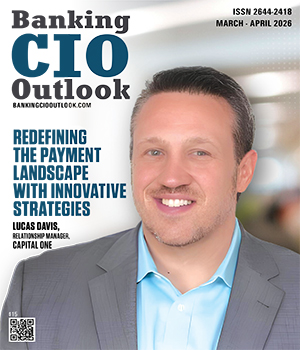
Lucas Davis has been a driving force behind the payment industry’s transformation, streamlining and securing B2B transactions. Through strategic leadership, he spearheaded the adoption of virtual payment solutions, enhancing payment efficiencies and supporting supplier enablement. In an interview with Banking CIO Outlook, Lucas shares insights on transformative technology advancements that are paving the way for a promising future and ongoing growth in the tech-driven sector. Can you describe your journey in the industry and your current roles and responsibilities at Capital One? I began my career in the credit card and business payment space around 23 years ago at American Express. Initially, I started as a small business service and sales representative. Over the years, I worked my way up through various roles, including team leader, manager of business development, and director in the global space. After 21 years at American Express, I joined Capital One as the Vice President for Commercial Cards, managing the Arizona market. My responsibilities involve mid-size customers and optimizing the payment process, especially through virtual cards, aligning with the industry’s trend toward streamlining processes. How has the payment and card space evolved lately, and what is your view on its current status? The industry has become more competitive in recent years. A decade ago, there weren't many salespeople actively pitching multiple payment platforms. Banks issued business credit cards, but they didn’t have an active sales force pushing their products. Now, numerous companies, including Capital One, have sales forces actively prospecting the same clients. The competition has become more driven, offering higher incentives and more aggressive pricing strategies. Post-COVID, the competition has intensified, with companies determined to differentiate themselves beyond traditional reward programs. The focus has shifted to creating new revenue str
Why should compliance and risk controls be embedded into payment infrastructure? After years working inside high-risk jurisdictions and complex payment environments, Gina LeBlanc and Gidget Reynolds recognized a structural flaw they had seen repeatedly: payment platforms optimized for growth often treated compliance and risk as secondary layers rather than foundational design principles. Businesses were left managing regulatory exposure, chargeback disputes, and operational uncertainty only after transactions had already moved. Determined to address risk at its source, they founded LockTrust around a simple principle: payment infrastructure should prevent risk by design, embedding compliance and intelligent controls directly into the system instead of managing problems after they occur. LockTrust operates as a compliance-native payments infrastructure platform, providing onboarding, transaction processing, monitoring, routing, custody and escrow capabilities within a single risk-managed system. As digital payments expanded across borders and regulatory regimes, this risk-first approach became the company’s defining architecture, reinforced further when Johnny Ritzer, co-founder and CRO, joined to embed compliance across onboarding, monitoring, routing, and custody. Within this architecture, Sagar Kotak, founder, was brought in to code and oversee the development of AI functions as the primary control mechanism. It dynamically adjusts onboarding flows, flags behavioral anomalies, enforces multi-layer jurisdictional checks, and reduces fraudulent chargebacks by capturing device-level intelligence..


Circeo is on a mission to reimagine lending in the digital era by easing the journey for both lenders and borrowers. It helps lenders navigate the increasingly complex regulations while meeting borrowers’ expectations for seamless digital experiences. TheLoanFactory, Circeo’s proprietary cloud-native, end-to-end lending and leasing SaaS platform, is a game-changer in credit management. The ISO 27001-certified platform brings a modular architecture, no-code/low-code automation and built-in compliance features. It empowers banks and financial institutions to modernize lending and deliver quick, hassle-free loan approvals and disbursements to borrowers. “We give lending institutions the tools to lend smarter and serve customers better, while staying compliant and future-ready,” says Laurent Clerc, chairman of the executive board. Designed for scale and speed, the platform enables lenders to handle a wide spectrum of customer segments, distribution channels and products like personal loans, mortgages, SME financing or more complex ones like BNPL. From origination and customer onboarding to account management, servicing and collection, TheLoanFactory simplifies all aspects of loan lifecycle management. Battle-tested across markets, it is the first-ever digital lending platform that delivers multi-channel flexibility by unifying loan management across all channels. Lenders can manage each distribution channel without duplicating infrastructure or forfeiting control. For instance, an application started online can be completed at a dealership. Customers receive pre-approvals on mobile. This convenience is in line with borrowers’ expectations for seamless lending experiences, whether through branches, mobile apps, dealerships or online platforms. TheLoanFactory's unmatched configurability distinguishes it. Its microservices-enabled architecture enables lending institutions to swiftly build, integrate and scale any fintech ecosystem. They can deploy custom workflows across front-office, middle-office and back-office operations—all without writing a single line of code.
ATM Consultants is a one-stop shop for all ATM needs. It offers comprehensive ATM outsourcing solutions for cash dispensers, full-function ATMs and ITMs, customized to each financial institution’s unique requirements. ATM Consultants lifts the burden of day-to-day ATM oversight from branch teams by taking charge of key tasks like cash forecasting, cash replenishment, first-and second-line maintenance and 24/7 monitoring. This allows financial institutions to reallocate internal resources toward member engagement, strategic planning and long-term growth. “We become our client’s ATM department,” says Chris Delzotti, president. The deep operational involvement is rooted in decades of expertise. While ATM Consultants has been in business for about a decade, its executive team brings ATM industry experience dating back to the 1980s, serving financial institutions with unmatched insight and foresight. Without a specialized partner like ATM Consultants, many institutions face mounting operational hurdles. These include fragmented vendor management, misdiagnosed service issues, incorrect dispatches, prolonged outages and escalating costs. The ever-increasing complexity of ATM technology, combined with mandatory compliance updates and regular software upgrades, only adds to the strain. ATM Consultants addresses these demands head-on by assuming full responsibility for security and compliance management, enabling institutions to stay compliant, efficient and focused on their core operations. To ensure every client receives the right solution, it begins each engagement with a consultative discovery process. By evaluating ATM usage patterns, uptime statistics and strategic objectives, it crafts tailored recommendations aligned with each institution’s operational requirements and cardholder needs. For example, lower-traffic branches may benefit from basic cash dispensers, whereas ITMs are better suited for locations aiming to reduce in-branch staffing or strengthen community engagement. Building on its strategic evaluations, ATM Consultants designs service plans that match each institution’s budget and support requirements, ranging from five-day to full seven-day coverage. It also helps clients meet the obligations of surcharge-free ATM networks. It manages every detail, from configuring compliant hardware and transaction routing to installing proper signage and managing compliance, ensuring clients can offer seamless, fee-free ATM access without administrative overhead.


Alex Carriles, Chief Digital Officer (CDO), EVP, Simmons Bank

Jerry Duan, Senior Vice President, Director of Credit Risk Models,United Community Bank

Stephanie McClendon, Chief of Community Banking, First Federal Bank

Michael Noftsger, Chief Administrative Officer (CAO), Forcht Bank

Emmelda Lawrence, Sr. Manager, Digital Servicing, Fremont Bank
AI payment solutions enhance speed, security, personalization, and automation in digital transactions, enabling businesses to deliver frictionless user experiences while reducing fraud, costs, and operational inefficiencies.
AI payment solutions enhance transaction efficiency, strengthen security, improve personalization, optimize operations, and create resilient, data-driven financial ecosystems that support continuous innovation.
Scaling Digital Banking with Structural Discipline
Recognized as Top AI Payment Solution 2026, LockTrust has built a compliance-native payments infrastructure that embeds risk controls directly into onboarding, transaction monitoring, routing and custody. Rather than layering compliance onto growth, its AI-driven control framework dynamically adapts onboarding flows, enforces jurisdictional checks and applies device-level intelligence to mitigate fraudulent chargebacks. Its patented escrow framework further structures peer-to-peer and marketplace transactions by holding funds in custody until agreed conditions are satisfied, reducing exposure while preserving transactional efficiency. The company’s operating philosophy is clear: scale only when governance mechanisms are strong enough to sustain it.
The leadership perspectives in this issue underscore that infrastructure alone does not resolve digital complexity. Stephanie McClendon, Chief of Community Banking at First Federal Bank, emphasizes that technology must remain a customer convenience rather than a substitute for relationships. Alex Carriles, Chief Digital Officer (CDO), EVP at Simmons Bank, identifies a “Digital Paradox” in which institutions promote mobile adoption while misaligning onboarding design and channel strategy with the behavioral realities of different customer segments. His call for end-to-end journey design rooted in user preference, not channel economics, exposes a persistent execution gap.
Sustainable digital banking demands compliance engineered into the core and customer experiences designed with precision. The institutions featured in this issue demonstrate what that standard looks like in practice. We invite readers to explore the full conversations and assess how their own architecture, controls and customer strategies align with the realities shaping modern banking.

Banking CIO Outlook Weekly Brief
Be first to read the latest tech news, Industry Leader's Insights, and CIO interviews of medium and large enterprises exclusively from Banking CIO Outlook